



How do you install logs to build a pétanque court?
Creating a pétanque court provides a welcoming and durable space to play with family or friends. To ensure a stable and well-defined court, installing edging is an essential step. Wooden logs are particularly popular for their natural look and their ability to hold the various materials that make up the court in place.
But how do you properly secure the logs to prevent them from shifting over time? The choice of anchoring system depends largely on the type of soil, the diameter of the logs, and the stresses the edging will be subjected to. Hammer-in anchors, screw-in anchors, rebar, or brackets can be used depending on the layout of the court.
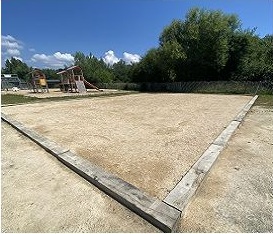
Why secure the logs on a pétanque court?
The logs do more than just provide an aesthetic finish to the court. They form a true border that keeps the game materials contained and maintains a clearly defined playing surface.
Over time, foot traffic, ground movement, and weather conditions can cause the edging to shift if it is simply placed on the ground. Proper fastening therefore keeps the logs in place and minimizes their movement over time.
Stabilizing the edging and securing the playing materials
The various layers of a pétanque court rest within a frame delineated by the edging. In particular, the edging helps prevent gravel and finishing materials from spilling out to the sides. Wooden edging is one of the most common solutions used to frame a playing surface.
Proper fastening offers several advantages:
- it keeps the logs in place;
- it limits movement of the edging;
- it preserves the shape of the court;
- it helps keep play equipment within the area;
- it improves the durability of the playground.
The goal, therefore, is to create a border that is rigid enough to withstand daily wear and tear, while choosing a fastening system suited to the terrain.
What fasteners should you choose to secure logs?
There is no single fastening method that works for all sites. The choice depends, in particular, on the nature of the soil and the configuration of the logs. To choose the right fastener, you must also consider the length of the anchor and the height of the log. The more stress the edging is under, the more carefully the fastener must be sized.
Loose or sandy soil → screw-in anchors and anchor discs
In loose or sandy soil, it is important to choose a fastening system capable of providing a secure hold in the ground. Corkscrew-type anchors or screw-in anchors allow the fastener to penetrate the soil and provide adequate support for this type of terrain.
Anchor discs are another fastening solution. The system consists of a ribbed, galvanized steel anchor disc paired with an anchor rod. The disc, which has a diameter of 120 mm according to the Fenox line, is designed to increase the contact area with the ground and improve the anchor’s stability. It is installed using a disc wrench.
The anchor disc is particularly useful in loose soil, but it is not the preferred solution for securing wooden logs. Instead, it is best used for securing end posts.
Compact or stony soil → Fenox rebar and hammer-in anchors
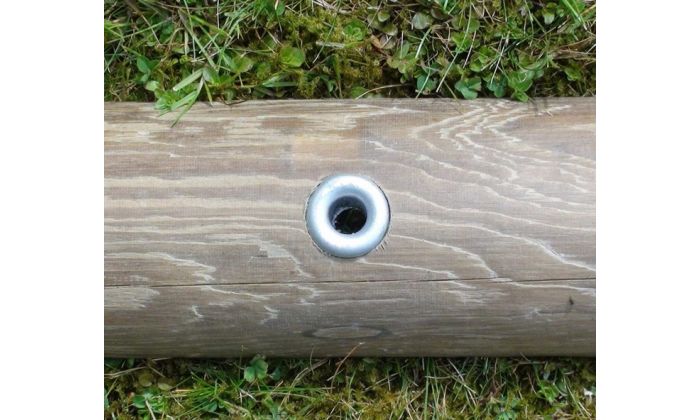
When the ground is particularly compact or contains many stones, installing a conventional fastener can be more difficult. Reinforcing bars can then provide a simple solution: simply drill a suitable hole in the log, then drive the bar into the ground to secure the edging to the ground.
Another option is to use Fenox percussion anchors. This system consists of a galvanized steel anchor equipped with anchor rods that spread out into the ground. Installation requires a specialized tool: specifically, a drill chuck and a driving tool.
At e-viti, Fenox percussion anchors are specifically designed for securing wooden logs, landscape edging, and parking stops. Their expandable-rod system is designed to improve resistance to pull-out.
Watch the video on how to install Fenox hammer-in anchors for wooden logs :
Corners and Joints → Brackets, Screws, and Mounting Brackets
Corners are particularly important areas when creating a pétanque court. This is where multiple logs meet and must remain perfectly aligned.
To reinforce the joints, you can use metal brackets, wood screws, or mounting brackets. These components can supplement the ground anchoring and prevent the logs from spreading apart or coming loose.
For a border made up of multiple sections, be sure to reinforce each joint rather than relying solely on the fasteners at the ends.
Installation Tips for Stable Logs
The quality of the installation depends as much on the materials used as on the preparation of the site. Before you begin, take the time to precisely determine the location and dimensions of your site.
Marking, Leveling, and Positioning the Edging
Start by marking the outlines of the future court using stakes and a string line. This step allows you to verify the dimensions and, most importantly, check the alignment of the future edging.
The ground must then be prepared and leveled to ensure a smooth base. For a pétanque court, proper ground preparation and leveling are essential for achieving a stable surface and promoting good drainage.
Next, position the logs, following the layout precisely. Check their alignment using a level and verify the angles before securing them permanently.
Tip: Don’t secure all the pieces right away. First, position all the logs to verify that the joints and angles are properly aligned.
Secure the logs and check their stability
Once the edging is properly positioned, secure it according to the type of soil and the system you’ve chosen.
For a hammer-in anchor, use the tools provided for its installation to avoid damaging the anchor. On our website, we offer specific chucks and driving tools designed to work with Fenox anchors.
After each fastening, check that the log does not move excessively. Also check the overall alignment of the edging. A properly secured fastening should hold the log firmly in place while maintaining a uniform edging along the entire length of the property.
Finally, perform a final inspection after the various layers of the court have been laid. The weight of the materials and the compaction process can place additional stress on the edging.
Beyond the pétanque court: other uses for logs
Wooden logs aren’t just for creating pétanque courts. Their durability and natural appearance make them particularly versatile elements for outdoor landscaping.
In particular, they can be used to:
- delineating a driveway or path;
- creating landscape edging;
- contain materials or landscaped areas;
- building wheel stops and parking bumpers;
- organizing an outdoor space;
- demarcate different areas in a garden or public space.
The anchoring systems available on our website www.e-viti.com can thus be used for various outdoor landscaping applications. The product line includes, in particular, tie-downs for securing logs, corkscrew anchors, and the tools needed to install hammer-in tie-downs.
Choosing the Right Anchor for a Durable Installation
To successfully install logs, the choice of fastening must always take into account the nature of the soil, the type of log, and the stresses placed on the edging. Loose soil, compacted soil, or particularly stony ground do not necessarily require the same solution.
By taking the time to properly prepare the ground, precisely position the logs, and choose a suitable anchoring system, you can create a stable and durable edging, whether for a pétanque court or many other outdoor projects.
Discover thelog tie-down and anchoring solutionsavailable on e-viti and choose the fastening system best suited to your project.