



How do you install a parking speed bump?
In a parking lot, controlling vehicle speed is essential to reduce the risk of accidents and ensure pedestrian safety. Near an entrance, an exit, a crosswalk, or in an area with limited visibility, a parking speed bump encourages drivers to slow down.
But to be truly effective, a speed bump must be properly selected and installed. The type of surface, the speed bump model, and the mounting system used are particularly important factors to consider before beginning the work.
So, how do you install a parking speed bump properly? What fasteners should you use on concrete or asphalt? Here are the main steps to follow.
Why Install a Speed Bump in a Parking Lot?
The primary purpose of a parking lot speed bump is to naturally reduce the speed of vehicles traveling through a private or commercial area. It forces drivers to slow down as they approach an area identified as sensitive.
This solution can be particularly effective in parking lots with high traffic volume, especially when vehicles and pedestrians are moving through the area at the same time.
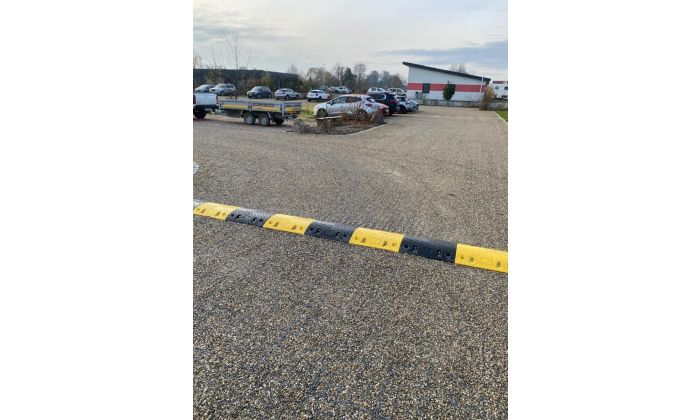
Ensuring Safety for Pedestrians, Vehicles, and High-Risk Areas
Areas in front of building entrances, near crosswalks, or close to loading zones can pose specific risks. Excessive speed reduces a driver’s reaction time and increases the potential consequences of a collision.
Installing a speed bump therefore helps designate an area where speed must be reduced. It can be installed, for example, before a crosswalk, an internal intersection, a high-traffic area, or a section with limited visibility.
Within a business, warehouse, or facility, speed bumps can also help better organize traffic flow among light vehicles, machinery, and pedestrians.
However, the device should not be viewed as a standalone solution. Safe traffic flow also depends on appropriate signage, visible road markings, and a coherent organization of traffic flows.
Choosing the Right Speed Bump and the Appropriate Ground Mounting
Before beginning installation, it is important to select a speed bump that is compatible with the environment in which it will be used. Its dimensions, height, durability, and ability to withstand repeated vehicle traffic must be appropriately suited to the traffic conditions.
The choice of mounting method then depends directly on the type of ground.
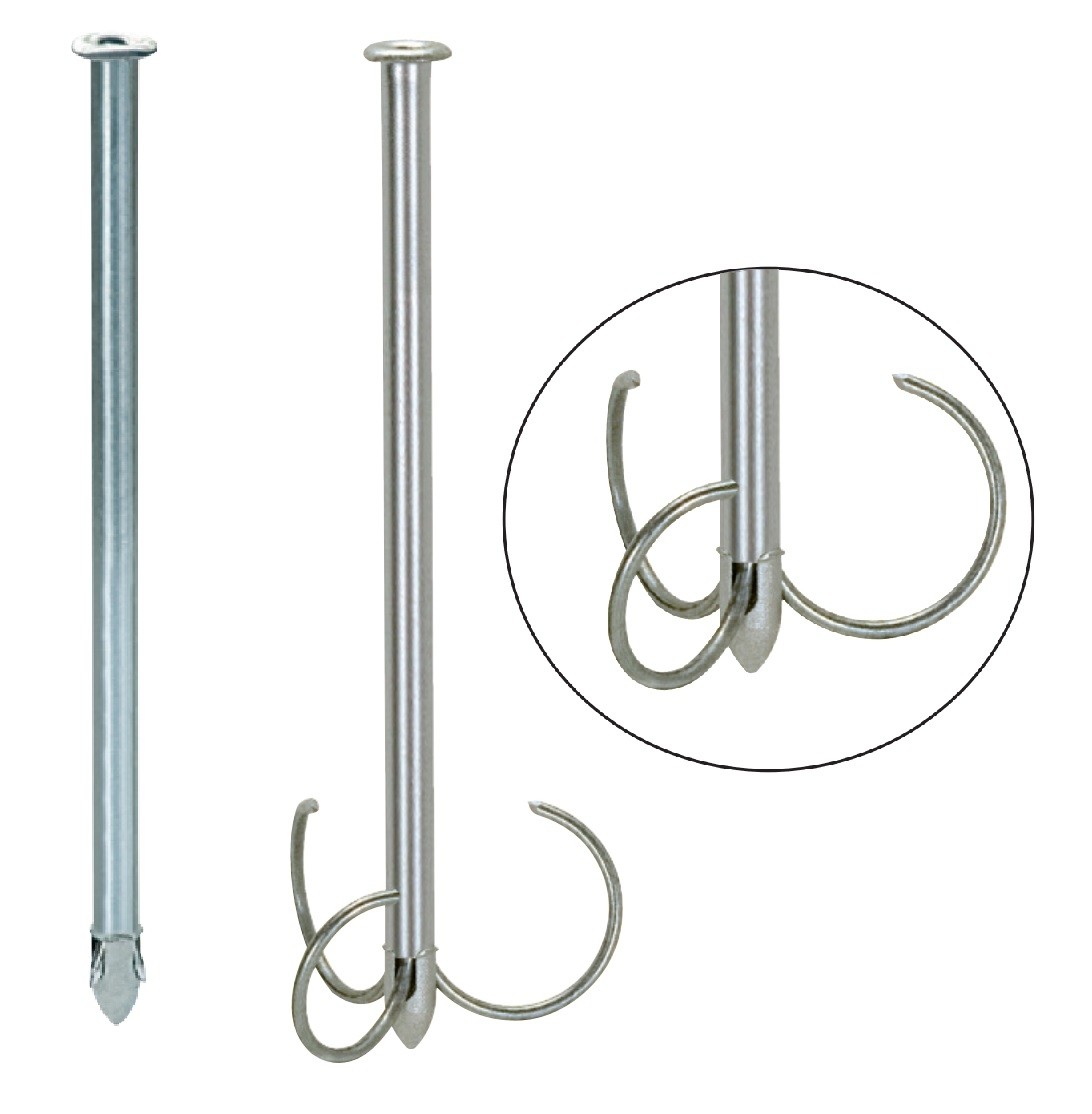
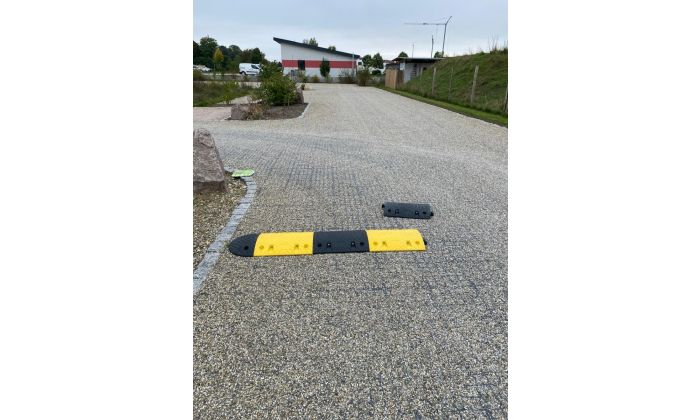
Stabilized gravel parking lot → Fenox impact anchors
On a stabilized gravel parking lot, installing a speed bump requires a solution suited to a surface made of aggregate, which does not have the same strength characteristics as a concrete slab or an asphalt pavement. The Fenox percussion anchor is an effective solution for securing certain equipment in this type of terrain.
It works by driving an anchor into the ground through impact, holding the equipment in place without the need for conventional drilling or chemical anchors. Before installation, it is essential to verify the compactness of the stabilized gravel, the nature of the underlying soil, and the anchor’s pull-out resistance. Installation must comply with the manufacturer’s recommendations and the specific requirements of the speed bump being used. Caution: A Fenox percussion anchor is not necessarily suitable for all speed bumps.
Concrete parking lot → anchor bolts, anchors, and lag screws
Concrete generally provides a rigid surface that allows for the use of various mechanical anchoring solutions.
Depending on the speed bump model and the manufacturer’s recommendations, installation can be carried out using suitable anchor bolts, anchors, or lag screws. The process involves drilling into the concrete at the designated locations, then inserting the fastening system before securing the speed bump to the ground.
The diameter and depth of the hole must match the specifications of the fasteners used. It is also important to verify that the substrate is sound enough and does not have any cracks or significant damage at the anchor points.
Asphalt parking lot → anchor bolts and anchors suitable for asphalt
Asphalt is more flexible than concrete. The choice of fasteners must therefore take this characteristic into account to ensure that the speed bump remains securely in place over time.
Anchors and bolts specifically designed for asphalt can be used when the system is compatible with the surface. Fasteners should be selected based on the thickness and condition of the asphalt, as well as the stresses caused by vehicle traffic.
Before drilling, it is recommended to check the overall condition of the pavement. Asphalt that is severely deteriorated, cracked, or too thin can compromise the fasteners’ hold.
Temporary Installation → Adhesive Solutions or Removable Devices
In certain situations, the installation may be temporary. This is particularly the case during construction, temporary traffic rerouting, or when it is not desirable to drill permanent holes in the ground.
Adhesive solutions may then be considered for certain models, provided the manufacturer authorizes them and the substrate is fully compatible with the adhesive used.
There are also speed bumps or speed-reduction devices designed to be more easily removed or relocated. These solutions may be beneficial when the layout of the parking lot is likely to change.
Steps for Installing a Parking Lot Speed Bump
Once the speed bump and mounting system have been selected, installation must be carried out with precision. Improper positioning or insufficient tightening can cause the modules to shift, become deformed, or lose stability.
Position the modules and mark the mounting points
The first step is to precisely determine the speed bump’s location. It must be positioned perpendicular to the direction of traffic so that vehicles drive over the entire structure correctly.
When the speed bump consists of multiple modules, begin by placing them on the ground and checking their alignment. The modules must fit together properly to ensure an even installation across the entire width of the lane.
The locations of the mounting holes can then be marked directly through the pre-drilled holes on the modules.
Before drilling, it is essential to double-check the device’s positioning and ensure there are no utility lines or installations that could be damaged.
Drill into the ground, insert the anchors, and secure the lag screws
Drilling is performed using equipment suitable for the type of substrate. On concrete surfaces, a drill equipped with a concrete-grade drill bit is generally required. For asphalt, the equipment and technique must be adapted to the chosen fastening system.
The holes must meet the diameter and depth specifications recommended by the fastener manufacturer.
After drilling, the holes must be thoroughly cleaned to remove dust and debris that could interfere with the installation of the anchors or fasteners.
The fasteners are then inserted before installing the lag screws, studs, or other specified components. Tightening should be done gradually to ensure the speed bump is properly secured to the ground.
It is best not to overtighten the fasteners: proper tightening effectively secures the device without damaging the modules.
Check the tightness, alignment, and stability of the speed bump
Once all fasteners are installed, a general inspection must be performed.
In particular, verify that each module is properly aligned and that no part of the speed bump moves or lifts. The fasteners must also be properly tightened.
A visual inspection helps identify any defects: gaps between modules, misaligned fasteners, damaged components, or speed bumps that are not resting properly on the ground.
This inspection is particularly important before reopening the area to traffic.
Plan for Signage and Maintenance of the Speed Bump
A speed bump must be sufficiently visible so that drivers can anticipate its presence. Its color, reflective strips, and nearby signage all contribute to this visibility.


Ensure the speed bump is visible both day and night
In a parking lot used at night or in a dimly lit area, the speed bump’s visibility is particularly important.
Models equipped with contrasting or reflective elements make the speed bump easier to identify. Vertical signage or road markings can also complement the installation when necessary.
The goal is to enable drivers to identify the speed bump early enough to adjust their speed before crossing it.
Regularly check the condition of the modules and fasteners
Like any equipment subject to repeated vehicle traffic, a speed bump must be inspected regularly.
Inspections allow for checking the condition of the modules, their alignment, and the tightness of the fasteners. Special attention should be paid to areas subject to heavy traffic or the passage of heavy vehicles.
If a fastener becomes loose, a module cracks, or the speed bump begins to shift, it is best to take action quickly. A defective fastener can gradually lead to further deterioration of the speed bump and pose a risk to road users.
Regular maintenance therefore helps maintain the speed bump’s effectiveness and extend its service life.
Beyond Parking Lots: Where to Install a Speed Bump?
Speed bumps are not limited to public or private parking lots. They can also be used in various commercial or residential settings where traffic flow needs to be better controlled.
In warehouses and logistics areas, they can help slow down vehicles near loading docks, building entrances, or pedestrian walkways.
In condominium complexes, they can be installed on certain private roads or in residential parking lots to limit vehicle speed.
Schools and their traffic areas may also require special attention when vehicles and pedestrians share the space. In this type of environment, signage and the overall traffic layout must be designed in a consistent manner.
Finally, private roads, industrial sites, farms, and other commercial areas can be equipped with speed-reduction devices when the site’s layout warrants it.
The installation of a parking speed bump therefore depends on several factors: choosing equipment suited to the traffic, selecting a mounting method compatible with the ground, following the installation steps, and ensuring regular inspections. A properly installed speed bump remains stable, visible, and effective over time.