



Why measure SO2 in wine?
In the production of quality wine, monitoring sulfur dioxide (SO₂) plays a vital role. This additive, traditionally employed by winemakers, plays a key role in preserving aromatic freshness, protecting color and ensuring the wine's microbiological stability. But its use requires great precision: too little, and the wine risks oxidation or the development of undesirable micro-organisms; too much, and the gustatory balance as well as compliance with legal standards may be compromised. Regular measurement of SO₂, whether free or total, thus enables the right dosage to be found, guaranteeing the safety, quality and longevity of the wine.
1. What is SO2 (sulfur dioxide) in wine?
- Antioxidant properties: protection against oxidation
It protects wine aromas and color by limiting oxidation. Regular monitoring prevents loss of freshness, the appearance of oxidized notes (chard apple, walnut) and wine browning. - Antiseptic action: control of undesirable yeasts and bacteria
SO₂ inhibits the development of undesirable yeasts and bacteria that could alter the wine (acetic pitting, refermentation in the bottle, etc.). Measuring its concentration ensures that there is enough to protect the wine, especially during ageing and bottling. - Antioxidant role: inhibition of oxidative enzymes
SO₂ inhibits the action of oxidative enzymes naturally present in must or wine. These enzymes, mainly tyrosinase (derived from grapes) and laccase (produced by the fungus Botrytis cinerea), catalyze the oxidation of phenolic compounds and lead to premature browning, loss of aroma and alteration of color.
2. Why and when should SO2 be measured during the winemaking process?
Measuring sulfur dioxide (SO₂) throughout the winemaking process is essential routine monitoring, as sulfite concentration naturally varies at each stage. It enables us to adjust additions to guarantee both wine protection, organoleptic quality and compliance with legal standards.
SO₂ measurement is essential for :
- To ensure the stability and proper conservation of your wine : Free SO₂ is the agent that is really active against oxidation and the proliferation of undesirable yeasts or bacteria. Monitoring its level helps to ensure that it remains sufficient to prevent spoilage.
- To control the aromatic profile and avoid defects : SO₂ also helps to maintain the taste balance, as an excess causes pungent or sulfurous odors, while a deficiency exposes the wine to oxidation defects.
- To comply with current regulations : The total SO₂ content (free + combined) is framed by legislation, with different limits depending on the type of wine (red, white, sweet, organic). The measurement prevents the limits from being exceeded.
Control must be regular, with key moments:
- Upon reception of grapes or must: to adjust the first sulfiting and limit the activity of oxidizing enzymes and micro-organisms.
- During alcoholic fermentation: to ensure that free SO₂ is not too high, so as not to inhibit yeasts.
- After malolactic fermentation (for reds): once the lactic acid bacteria are active, it's essential to check and correct the free SO₂ to protect the now more vulnerable wine.
- During ageing: regular checks (every 4 to 6 weeks or so) help compensate for losses due to oxidation or natural combination.
- Before bottling: final crucial dosage to ensure that the wine leaves with a level of free SO₂ sufficient for its preservation and that the total remains in compliance with regulations.
3. Methods for analyzing and measuring SO2 in wine
- The Ripper method: principle and implementation
This is the official method most widely used in wine analysis laboratories. The principle is that wine is acidified to release SO₂, which is carried away by a flow of air (or nitrogen) to a solution of hydrogen peroxide. This oxidizes the SO₂ to sulfuric acid, which is then assayed by titration using an indicator (e.g. fuchsin). This method is suitable for free and total SO₂, the analysis time is relatively long compared to the titrator method.
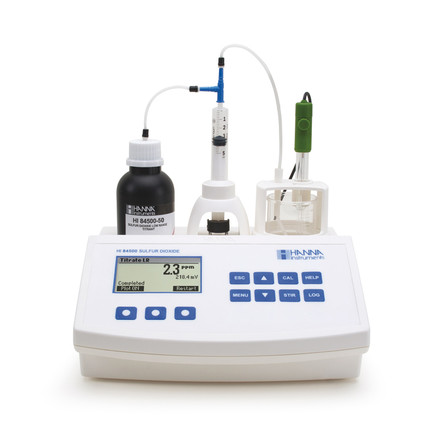
- Modern measurement techniques: automatic titrators and analyzers
These devices adopt the principle of Ripper dosing (oxidation of SO₂ by iodine), but perform it in a fully automated way. It's a faster, simpler method, often used in wineries. The principle is that, in an acid medium, SO₂ is oxidized by an iodine solution, the end of the reaction being marked by a starch indicator (blue turn).
At e-viti, we work with a key player in the field of physico-chemical and analytical instrumentation, Hanna Instruments. With recognized expertise and a range of innovative products, the brand meets the needs of professionals in oenology, viticulture and many other demanding sectors. Discover on e-viti the Hanna Instruments solutions that combine precision, reliability and ease of use.
- Recommended doses according to winemaking stage and wine type
The doses of sulfur dioxide (SO₂) to be applied depend on the type of wine, its pH, the presence of residual sugars and the stage of vinification. The aim is to have enough free SO₂ to protect, without exceeding the legal limits for total SO₂.
The figures below are indicative orders of magnitude, to be adjusted according to regular free SO₂ analyses, vintage and wine sensitivity.
- Before or at pressing (must)
Purpose: to limit enzymatic oxidation (antioxidase) and curb undesirable flora.
Suggested dosage:
White/pink wines: 30-50 mg/L total SO₂.
Red wines: 20-30 mg/L (tannins already partially protect).
If grapes are botrytized (presence of laccase): up to 60-80 mg/L.
- Start of alcoholic fermentation
Purpose: to protect the must before fermentation starts, without blocking the yeasts.
Indicative dosage: generally no additional addition if initial sulfiting has been well managed.
If necessary (high pH > 3.5): small correction of 10-20 mg/L free SO₂.
- End of alcoholic fermentation
Purpose: to protect the wine while awaiting malolactic fermentation (MLF).
Indicative dose:
Before MLF (if desired): no or very little SO₂ so as not to inhibit lactic acid bacteria (<10 mg/L free).
If no MLF planned (e.g. certain dry whites): adjust to 20-30 mg/L free.
- After MLF (especially for reds)
Purpose: to stabilize the wine and prevent bacterial pitting.
Indicative dose: adjust free SO₂ according to pH:
pH 3.2: ~25-30mg/L free
pH 3.4: ~30-35mg/L free
pH 3.6: ~35-40mg/L free
(Objective: keep at least 0.8 mg/L of molecular SO₂, the truly antiseptic form).
- During rearing
Goal: compensate for losses due to natural combination.
Practice: check every month or every 6 weeks.
Adjustment: maintain free SO₂ within the range recommended above according to pH.
- Before bottling
Purpose: to guarantee microbiological stability during storage and transport.
Indicative dosage:
Dry wines: 25-35 mg/L free (depending on pH).
Sweet/liquor wines: 35-50 mg/L free, as the presence of sugars increases the microbial risk.
In short, control of sulfur dioxide during winemaking is the key to final quality. Its antioxidant, antioxidant and antimicrobial roles make it an essential ally, but its effectiveness depends directly on regular, precise monitoring. Appropriate measurements at every stage - from harvest to bottling - enable us to adjust the dosage to suit the pH, the type of wine and the desired style, while remaining within legal limits. Reasoned sulfiting is therefore not just a regulatory obligation: it is above all a guarantee of stability, aromatic freshness and longevity of the wine, while ensuring that the consumer enjoys a safe and harmonious product.